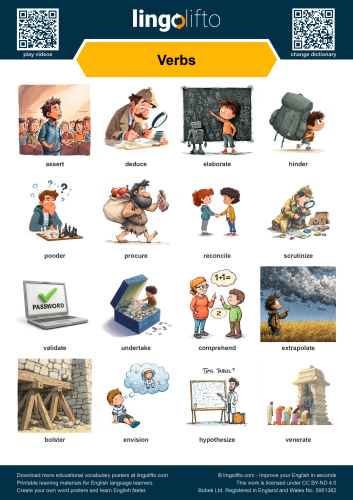
Professor Eleanor Cartwright sat in her candlelit study, determined to undertake the most ambitious research of her career. She wished to assert a new theory about human thought, one that could bolster philosophy and science alike. Yet she knew that to do so, she must carefully scrutinize every fragment of evidence, then validate her claims before the sceptical eyes of her peers.
She began to ponder late into the night, her mind tracing connections between history, mathematics, and poetry. Could she truly reconcile such opposing fields? To comprehend the vastness of the task, she tried to envision a framework where reason and imagination could stand side by side. “If I can elaborate this idea clearly,” she whispered, “I may procure not only recognition but also respect.”
Still, doubts threatened to hinder her progress. She would hypothesize, then quickly attempt to deduce consequences, only to discover contradictions. Each failure forced her to reflect more deeply, but she would not abandon the pursuit. Instead, she chose to extrapolate from small truths, building them into broader possibilities, step by careful step.
At dawn, she paused to venerate the thinkers of the past—Aristotle, Newton, and Darwin—who had faced similar struggles. “They too had to reconcile competing ideas,” she reminded herself, “and they too had to assert their voices against resistance.” This reverence gave her courage, as if their spirits sought to bolster her resolve.
Over the following weeks, Eleanor invited colleagues to her study. She asked them to scrutinize her notes, and when they questioned her reasoning, she would elaborate patiently, ensuring they could comprehend her vision. When objections arose that might hinder her work, she tried to reconcile them through careful dialogue, rather than dismiss them.
One evening, a fellow scholar challenged her directly. “You cannot simply hypothesize unity between such different disciplines without proof. How can you validate such a claim?” Eleanor closed her eyes, then began to deduce from simple examples: the harmony between geometry and music, the shared rhythm of language and logic. As she spoke, she managed to envision the very structure she had long sought.
At last, the moment came to present her work. Standing before the council, Eleanor chose her words carefully. She would not only assert her findings but also elaborate their implications, showing how they might bolster understanding across fields. Some listeners remained doubtful, but others began to venerate her courage and insight.
When the debate ended, Eleanor smiled to herself. She knew her journey was not finished—further study would always be needed to validate, to extrapolate, and to reconcile. Yet she had taken the first step, and that step was enough.
For in her heart, she could finally comprehend what true scholarship meant: not certainty, but the relentless will to ponder, to hypothesize, and to seek truth without fear of being hindered.