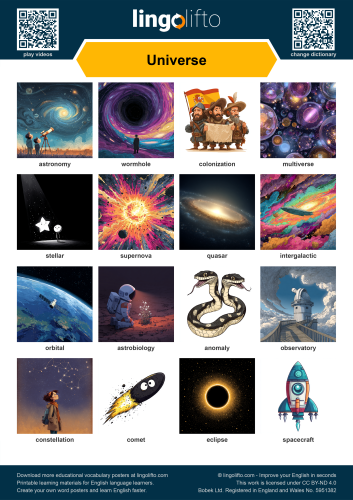
Professor Eleanor Hart had spent her life devoted to astronomy, but nothing in her long career had prepared her for the anomaly unfolding before her. From the high dome of the mountain observatory, her telescope captured what first appeared to be an ordinary comet drifting past a constellation of stars. Yet the data revealed far more—a wormhole shimmering like a stellar wound in the very fabric of space.
Her colleagues spoke in hushed tones of the multiverse, of parallel realities where colonization had already begun on worlds unknown. Eleanor, however, remained sceptical until the readings confirmed orbital fluctuations and intergalactic distortions around the wormhole. No simple comet could cause such chaos.
The international council dispatched a spacecraft to investigate, and Eleanor was chosen as lead scientist. For her, it was a dream forged by decades of studying both astrobiology and cosmology. The mission promised not only answers about the anomaly but also the possibility of colonization beyond Earth. Her thoughts were filled with images of intergalactic voyages, human settlements beneath alien constellations, and thriving ecosystems predicted by the principles of astrobiology.
As the spacecraft reached proximity, they encountered their first marvel: a quasar blazing with unimaginable energy, its jets slicing through the void. The wormhole shimmered beside it, pulsing as though reacting to the quasar’s fury. Then, as if on cue, a supernova erupted in the distance, stellar light flooding their viewports in a spectacle of both creation and destruction. The crew sat in awe, a silence broken only by Eleanor’s whispered reminder: “Astronomy shows us not just where we are, but where we might go.”
The anomaly itself was unlike anything charted before. Their instruments measured gravitational distortions, time dilation, and orbital irregularities around the wormhole’s edge. Eleanor considered the implications for colonization: could a spacecraft survive the crossing? Could humankind step into the multiverse? Astrobiology suggested life might flourish under different stars, but what of the risks?
As they drew closer, an eclipse occurred—a distant planet sliding between its star and their view, casting shadows that danced across the wormhole’s light. It felt almost symbolic, as if the cosmos itself offered both warning and invitation. Eleanor thought of the countless constellations mapped over centuries and realised humanity stood on the brink of redrawing them entirely.
Suddenly, alarms blared. The spacecraft shuddered under immense gravitational pull. Eleanor gripped her console, eyes fixed on the wormhole as if it were a gateway to destiny. The anomaly threatened to consume them, yet she felt an odd serenity. Intergalactic exploration was never meant to be safe; it was meant to be transformative.
When the ship finally stabilised, Eleanor ordered one last scan. The wormhole flickered, then closed as swiftly as it had opened. The anomaly was gone, leaving behind the comet that had first betrayed its presence.
Back at the observatory weeks later, Eleanor stared again through her telescope. She knew astronomy had always been about questions, not answers. Yet she could not help but hope another wormhole might appear—another chance at colonization, another glimpse into the multiverse, another stellar reminder that humankind’s journey had only just begun.