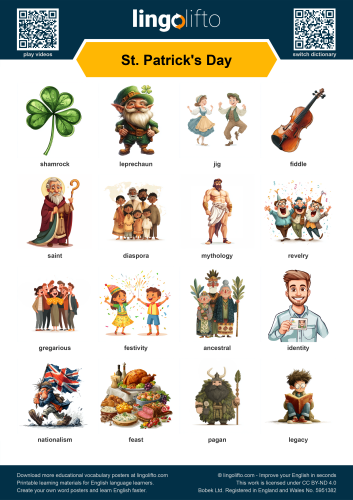
On the eve of St Patrick’s Day, the little village of Kilcairn was alive with colour. Children carried garlands of green shamrocks, while music spilled from every tavern. At the centre of the square, a group of fiddlers tuned their fiddles, ready to lead the night’s dance. It was said that if one listened closely, the faint laughter of a leprechaun might be heard between the notes of a reel.
The village prided itself on its traditions. Their festivity was more than mere celebration—it was a reminder of their ancestral roots, their shared identity, and the enduring legacy of their people. For them, the shamrock was not only a plant but a symbol of survival, of how faith and folklore had mingled for centuries.
Long ago, when Ireland first began to embrace the words of a saint, old pagan customs did not vanish. Instead, they wove themselves into new stories. Mythology mingled with scripture, and the result was a culture as rich as the soil of the fields. In Kilcairn, villagers saw no contradiction in dancing a lively jig while also raising prayers to their patron saint.
That night, the hall brimmed with revelry. The air was warm with the scent of roasted meats for the feast, and voices were gregarious, calling out songs and toasts. The diaspora, those who had returned from faraway lands, joined in eagerly. They said that such festivity reminded them of home, even if they had been away for decades.
One fiddler began a tune so quick that the crowd could not resist. Feet stamped, skirts swirled, and soon a great circle formed. “A jig for the ancestors!” cried old Seamus, raising his cup. Laughter followed, for in that moment, the whole village seemed bound by one heartbeat.
Yet amid the cheer, there was always talk of deeper things. “Our identity,” said Father O’Connor, “comes not just from songs or shamrocks, but from the strength of our ancestral spirit.” Others spoke of nationalism, the pride in their homeland and the duty to protect its legacy. For them, even a simple feast carried meaning—it was an act of remembrance as much as joy.
By the fire, Niamh told her children an old tale of a wandering leprechaun who guarded a pot of gold at the end of a rainbow. “But,” she added, “his true treasure was not gold at all. It was the stories he carried, the threads of our mythology.” The children clutched their little shamrocks tighter, eyes wide.
As the night drew on, the revelry softened. The last tunes on the fiddle faded, and the people left with hearts full of warmth. Kilcairn had once again honoured both its pagan past and its Christian saints, weaving together faith, story, and song.
And so, the shamrock remained more than a plant—it was the living emblem of Ireland’s identity, a reminder that from every diaspora, every feast, and every step of a jig, the people carried their ancestral legacy forward.