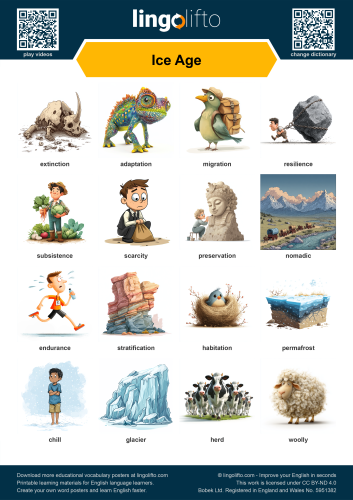
Long before cities rose upon the earth, when the great Ice Age ruled the north, life was a fragile balance between survival and extinction. For every creature that vanished into extinction, another survived only through careful adaptation to the cold.
A small nomadic tribe moved slowly across the endless tundra, their lives shaped by the glacier towering to the west. They followed the herd of woolly mammoths, for these giants offered food, fur, and bone tools. The tribe’s very subsistence depended on the herd, and yet scarcity haunted them. When the herd wandered too far, hunger and scarcity pressed in.
The people knew the journey demanded endurance. Each step across the icy plains tested their strength. Their endurance was not only physical but spiritual, for they carried stories of ancestors who had crossed frozen rivers and survived storms that froze men where they stood.
At night, they gathered around a fire, speaking of preservation. Not just the preservation of food in pits carved into the permafrost, but also the keeping of memory and knowledge. The elders taught that only through adaptation could the tribe resist the chill of despair.
The chill was everywhere—biting wind against skin, frost creeping into shelters, and silence heavy with threat. Yet in this silence, the tribe saw beauty. They marvelled at the slow migration of the herd, their massive forms cutting black shapes against the white snow. They envied the mammoths’ thick woolly coats, a perfect adaptation to the frozen world.
But even mammoths could not escape time. Some said their habitation in the valleys would not last. As the ice retreated and the forests spread, their habitation would shrink, and one day, their bones would lie deep under the glacier, frozen in eternal sleep.
The tribe’s leader, Alaric, spoke often of resilience. He told them, “It is not the strongest who survive, but those with resilience, who bend without breaking, who learn without forgetting.” His words were repeated like prayers, echoing against the dark.
Still, the tribe faced scarcity with every passing season. Their way of life demanded not comfort, but discipline. Stratification within the group became clear: hunters, gatherers, elders, and children each had their role. This stratification kept order in harsh times, but it also reminded them that no one could live alone.
When a great storm swept across the land, the tribe sought shelter near the edge of the glacier. The ice cracked, revealing the dark bones of creatures locked in permafrost. Some saw it as a warning of extinction, others as proof of their own fragile habitation.
And yet, when dawn came, they rose again. Despite the chill, despite the scarcity, despite the endless march of migration and loss, they moved forward. Their subsistence was never easy, but their resilience made each step possible.
Thus, under the shadow of the glacier, between life and extinction, the story of endurance was written—not on paper, but in every heartbeat that refused to stop.